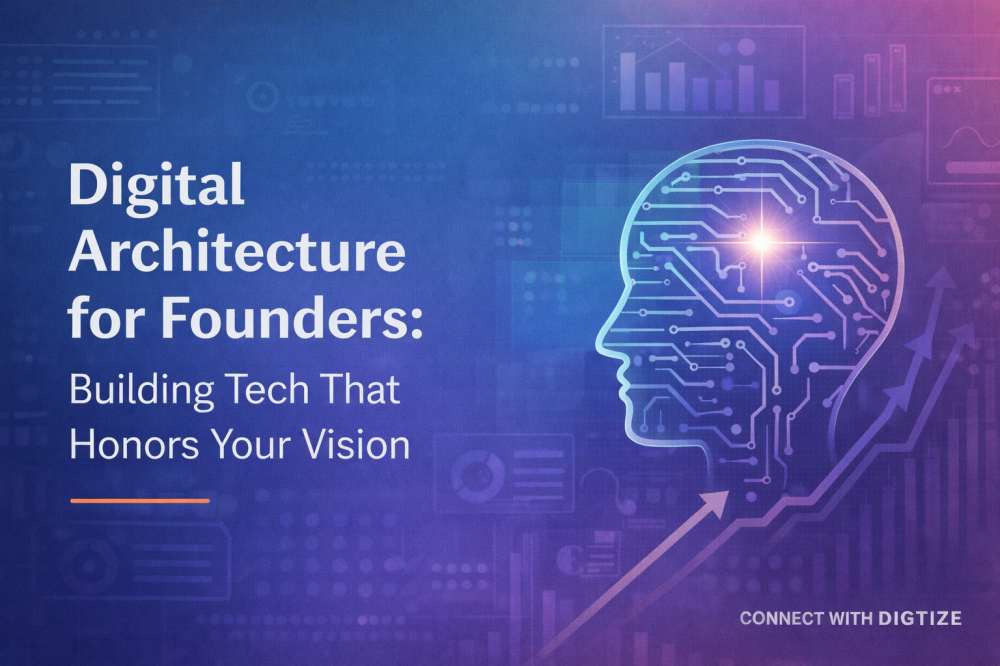
When Vision Meets Infrastructure
Every founder begins with a vision long before a product ever exists. It starts as a feeling, an itch that won’t go away. A frustration with how things are done. A quiet conviction that something could work better, feel better, or matter more. This vision is rarely technical at first. It’s human. Emotional. Purpose-driven.
But at some point, that vision must become real.
It must be translated into interfaces, systems, workflows, databases, and code. And this is where many founders unknowingly compromise what they set out to build, not because the vision was weak, but because the architecture built to support it didn’t listen.
Too often, technology is treated as an afterthought. Something to “put together” once the idea is validated. A collection of tools chosen for speed or convenience. But digital architecture is never neutral. The way systems are structured shapes how ideas move, how teams think, how customers experience the brand, and how growth unfolds over time.
Poor architecture doesn’t just slow execution.
It quietly reshapes the vision itself.
For founders, digital architecture is not a technical concern, it is a leadership decision. It determines whether your company grows in alignment with your intent or drifts into something unrecognizable.
To build tech that truly scales, founders must move beyond development and into architectural thinking: designing systems that respect intention, preserve meaning, and evolve without distortion.
Why Founder Vision Gets Lost Inside Technology
Founders rarely lose their vision all at once. It erodes gradually, almost invisibly.
It often begins with small compromises. A tool is chosen because it’s popular, not because it fits. A feature is added because competitors have it, not because users need it. A workaround becomes permanent. A temporary fix becomes core infrastructure. Each decision feels practical in isolation.
But systems remember.
Over time, these choices accumulate into a complex web. Data stops flowing cleanly. Teams adapt their behaviour to the tools instead of the other way around. Decisions are constrained by what the system allows. Innovation slows because changing anything feels risky.
The architecture begins to lead, and the vision follows behind.
At this point, founders often feel a subtle disconnection. The product no longer feels like an extension of their thinking. Growth feels heavy instead of energizing. Strategy meetings revolve around limitations instead of possibilities.
This isn’t a failure of ambition or discipline.
It’s a failure of structure.
Digital architecture has gravity. When poorly designed, it pulls the organization toward inefficiency, misalignment, and compromise. When designed intentionally, it does the opposite: it reinforces clarity, accelerates decision-making, and protects founder intent at scale.
The difference isn’t the tools themselves.
It’s the thinking behind them.
Architecture Is Strategy Made Permanent
Every system encodes beliefs.
What deserves attention?
What moves quickly?
What gets measured.
What gets ignored.
When architecture is built reactively, these beliefs are accidental. When it’s built intentionally, they become strategic advantages.
Founder-led companies have a rare opportunity here. Unlike legacy organizations burdened by outdated infrastructure, founders can design from first principles. They can ask deeper questions:
How should decisions flow?
Where should intelligence live?
How do we want users to feel at each touchpoint?
What should our systems encourage and discourage?
Architecture becomes strategy in physical form. It’s the silent partner that reinforces values, or quietly undermines them.
This is why digital architecture must be treated as a living framework, not a one-time build. It must be capable of learning, adapting, and scaling without losing coherence. It must absorb growth without forcing constant reinvention.
In other words, it must honour vision while enabling evolution.
Designing Architecture That Serves the Founder
Founder-aligned digital architecture begins with restraint. Not every tool is necessary. Not every feature adds value. Not every automation improves experience.
The first step is clarity, operational clarity.
Founders must define not just what they are building, but how the business should behave at scale. How decisions are made. How teams collaborate. How customers move through the experience. Architecture should then be designed to make those behaviours natural, not forced.
Instead of organizing systems around departments or tools, effective architecture is designed around flows:
how information moves,
how users progress,
how feedback loops close.
When flows are clear, complexity dissolves.
AI and automation play a critical role here, but only when applied thoughtfully. AI should reduce cognitive load, not increase it. It should surface insight, not noise. It should assist judgment, not replace it. The goal isn’t intelligence for spectacle, it’s intelligence in service of direction.
At DigTize, architecture is approached as ecosystem design. Frontend, backend, data, automation, analytics, each layer exists in conversation with the others. Nothing operates in isolation. Nothing is redundant. Every component earns its place.
This is how systems stay aligned even as they grow.
Building for Growth Without Betrayal
One of the deepest fears founders carry is that growth will dilute what made their company special. And that fear is justified when systems are built without foresight.
Founder-aligned architecture anticipates change. It assumes iteration. It welcomes expansion. But it does so without forcing painful rewrites or identity loss.
This requires modularity. Systems that can evolve piece by piece. Integrations that enhance rather than complicate. Data structures that remain meaningful as volume increases. Design systems that preserve brand essence even as features expand.
When architecture is right, growth doesn’t feel like loss of control.
It feels like amplification.
The founder’s role evolves. Less micromanagement. More stewardship. The system carries the operational weight. The vision remains intact.
That is not luck.
That is architectural discipline.
What Happens When Tech Honours Vision
When digital architecture aligns with founder intent, everything changes.
Teams gain autonomy because systems guide them. Decision-making accelerates because information is reliable and accessible. Customers experience consistency because every touchpoint reflects the same underlying logic and care.
Innovation becomes easier because the foundation supports experimentation instead of resisting it. New ideas don’t threaten stability; they build on it.
Most importantly, founders stay connected to what they’re building. The product still feels familiar, even as it grows. Strategy doesn’t get buried under execution. The company feels alive, not mechanical.
This alignment creates resilience. Markets shift. Tools evolve. Trends rise and fall. But architecture grounded in vision adapts without losing identity.
That’s how founder-led companies scale without losing their identity.
Build Architecture That Protects What Matters Most
Your vision deserves more than functionality.
It deserves infrastructure that understands it.
At DigTize, we work with founders who care deeply about what they’re building, and how it grows. We don’t just develop platforms. We design digital architecture that preserves intent, accelerates execution, and scales without compromise.
If you’re building something meaningful, your tech should reflect that meaning at every level.
Build systems that listen.
Design architecture that remembers why it exists.
And let your vision scale without distortion.
Connect with DigTize, where the founder's vision becomes enduring digital structure.
Written by: Ayomiposi Inawole