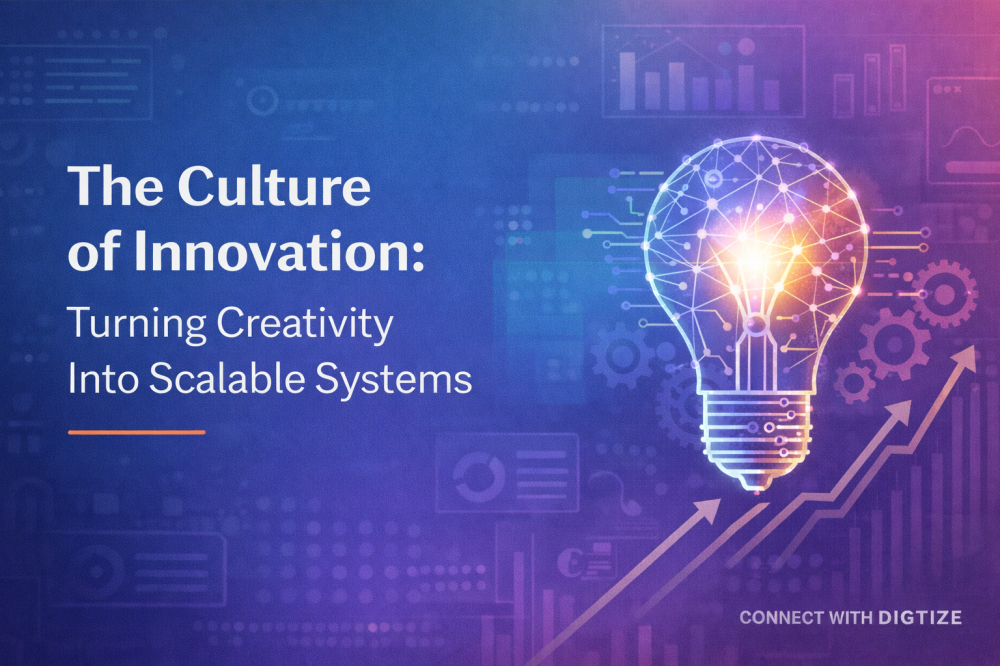
Creativity Is Easy. Scaling is the Real Challenge.
Every organization claims to value innovation. It shows up in vision statements, onboarding decks, and keynote speeches. Teams are encouraged to “think outside the box.” Brainstorming sessions are scheduled. Ideas flow freely, at least at first.
And yet, very few of those ideas ever make it past the room they were born in.
This isn’t because people lack creativity. In fact, most teams are overflowing with it. The real problem is what happens after inspiration strikes. Ideas need structure to survive. They need systems to move them forward. Without those systems, creativity becomes noise, energetic, exciting, and ultimately fleeting.
The companies that truly innovate don’t rely on bursts of brilliance. They design environments where creativity is protected, guided, and multiplied. They understand that innovation is not an event; it’s a condition. One that must be built deliberately.
Innovation doesn’t scale on enthusiasm alone.
It scales on architecture.
And architecture, whether cultural or digital, always shapes behaviour.
Why Most Innovative Ideas Never Become Reality
Most ideas don’t fail because they’re bad. They fail because the system surrounding them is not designed to carry them forward.
In many organizations, creativity exists on the margins. It shows up in isolated teams, passionate individuals, or special projects that sit outside daily operations. Meanwhile, the core systems, approval processes, workflows, KPIs, tools—are optimized for stability, predictability, and risk avoidance.
This creates tension.
Ideas slow down the moment they encounter real structure. Feedback loops stretch. Ownership becomes unclear. Execution gets postponed behind “more urgent” operational tasks. Over time, people learn an unspoken lesson: ideas are welcome, but acting on them is inconvenient.
So creativity adapts. It becomes safer. Smaller. More incremental. Innovation turns into decoration instead of transformation.
What’s often missed is that culture doesn’t shape systems as much as systems shape culture. When the infrastructure rewards caution, creativity fades. When it rewards speed, learning, and iteration, innovation flourishes naturally.
Innovation is not a people problem.
It’s a systems problem.
Creativity Needs Continuity, Not Applause
One-off innovation is easy. Sustainable innovation is rare.
Many companies celebrate ideas loudly but support them quietly, or not at all. Hackathons generate excitement. Innovation weeks produce presentations. But without continuity, nothing compounds. Each cycle starts from zero.
Scalable innovation requires memory. It requires systems that capture ideas, track experiments, measure outcomes, and feed learning back into the organization. Without this continuity, creativity resets every time a team changes or a quarter ends.
Digital systems are critical here. Not because technology invents ideas, but because it preserves them. It turns fleeting insight into institutional knowledge. It ensures that learning survives beyond individual contributors.
Innovation becomes less about genius and more about rhythm.
A steady loop of imagining, testing, learning, and refining.
That rhythm is what separates innovative cultures from creative ones.
Designing Systems That Turn Creativity Into Capability
To scale creativity, businesses must stop treating innovation as a personality trait and start treating it as an architectural principle.
This begins with intentional design. Systems must reduce friction between idea and action. When testing a concept feels bureaucratic, creativity slows. When experimentation feels safe and lightweight, ideas move faster.
That doesn’t mean removing structure. It means designing the right kind of structure, one that guides without constraining.
Automation and AI play a powerful role here. Not as replacements for imagination, but as enablers of it. Intelligent systems handle repetition, coordination, and data analysis, freeing human energy for thinking and exploration. They shorten feedback loops. They surface patterns faster. They allow teams to see what’s working before momentum fades.
At DigTize, we design digital ecosystems where creativity doesn’t die after ideation. Ideas flow into prototypes. Prototypes evolve through iteration. Iteration feeds strategy. Learning loops never break.
Innovation becomes operational, not chaotic.
Culture Is Engineered Through Daily Behaviour
You can’t declare a culture of innovation and expect it to appear. Culture is not what leaders say, it’s what systems allow.
People innovate when experimentation doesn’t threaten their credibility. When failure produces insight instead of blame. When curiosity leads to movement, not delay. These conditions don’t emerge by chance. They are built into workflows, metrics, and tools.
Digital systems quietly enforce values. What gets measured gets repeated. What gets automated becomes normal. What gets visibility becomes important.
When platforms surface insights quickly, learning accelerates.
When tools encourage collaboration, ideas spread.
When workflows reward iteration, innovation compounds.
Culture stops being abstract.
It becomes visible behaviour.
Scaling Innovation Without Burning Teams
One of the biggest misconceptions about innovation is that it requires constant intensity. In reality, scalable innovation requires sustainability.
Without systems, creativity becomes exhausting. People generate ideas on top of full workloads. Experiments feel risky. Momentum collapses under pressure.
With the right architecture, innovation feels lighter. Systems carry the operational weight. Teams focus on insight, not logistics. Creativity integrates into daily work instead of competing with it.
This balance is what allows innovation to scale without burnout. Growth doesn’t demand more energy; it demands better flow.
What Happens When Innovation Becomes a System
When creativity is supported by systems, innovation stops being sporadic and starts being reliable.
Ideas don’t pile up; they progress. Learning compounds. Teams see their thinking turn into outcomes. Motivation shifts from pressure to purpose.
From the outside, these organizations feel alive. Products evolve quickly. Experiences improve continuously. The brand feels responsive, intelligent, and ahead of the curve.
From the inside, work feels meaningful. People feel ownership. They stay engaged because their ideas matter, and they move.
This is the difference between creative companies and innovative organizations. One generates inspiration. The other builds futures.
Innovation as Competitive Advantage
Scalable innovation creates a quiet advantage. Competitors may copy features, but they can’t copy systems easily. When innovation is embedded into culture and architecture, it becomes difficult to replicate.
The organization learns faster. Adapts sooner. Evolves naturally. Markets shift, but momentum remains.
Innovation stops being a buzzword.
It becomes a capability.
Build Systems Where Innovation Can Live and Grow
Innovation doesn’t need more brainstorming sessions.
It needs better architecture.
At DigTize, we help businesses turn creative energy into scalable systems. We design digital ecosystems that capture ideas, accelerate experimentation, and transform learning into growth, without chaos or burnout.
If your organization has ideas but struggles to scale them, the issue isn’t creativity. It’s the system surrounding it.
Learning design.
Structure for experimentation.
And let innovation become a daily advantage, not a rare event.
Connect with DigTize, where creativity becomes capability, and innovation becomes scalable.
Written by: Ayomiposi Inawole