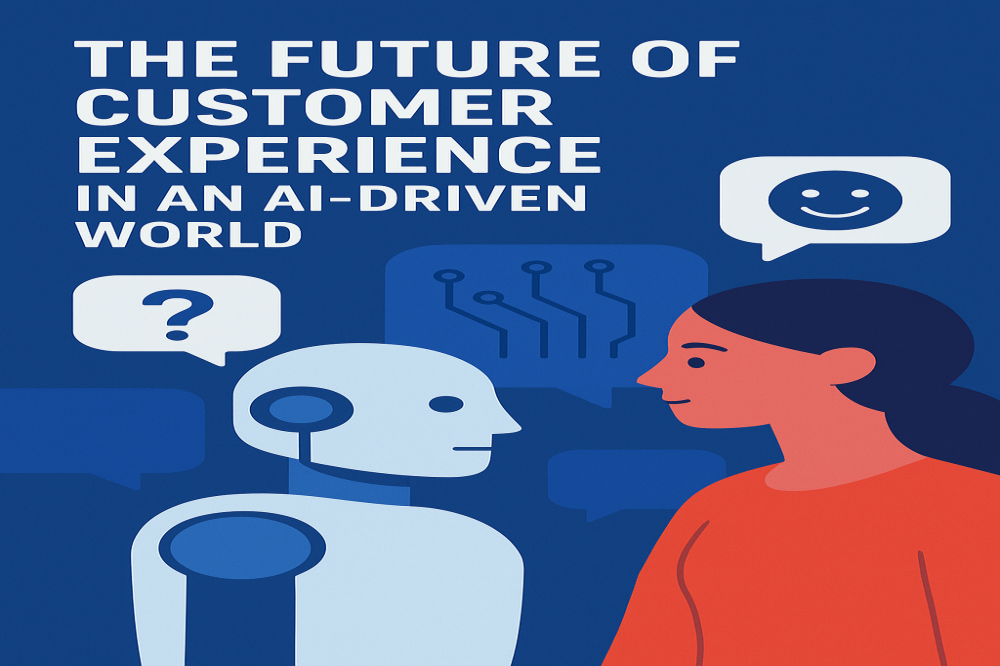
A New Kind of Connection
Once upon a time, customer experience was built on smiles, handshakes, and human intuition. The best brands knew how to make people feel something: warmth, trust, belonging. But today, the landscape has shifted. The front desk is now a chatbot, the salesperson is an algorithm, and the store is an app that fits in your pocket.
Yet the goal remains the same: connection
The world is spinning faster, attention spans shorter, choices infinite, expectations sky-high. Customers no longer compare you to your competitors; they compare you to their last best experience, anywhere. And increasingly, those experiences are being shaped by Artificial Intelligence.
From AI assistants predicting your needs before you speak, to personalized content crafted just for you, we’re entering an age where technology doesn’t just serve, it understands. But here’s the beautiful paradox: as machines learn to simulate empathy, humans must learn to design empathy into the machines.
Welcome to the future of customer experience, where AI doesn’t replace the human touch; it refines it.
The Rise of Intelligent Experience
AI has become the invisible architect behind modern customer journeys. It listens, learns, and responds, not just faster, but smarter.
Let’s break down how this silent revolution is transforming the art of experience.
1. Personalization at the Speed of Thought
The old marketing model was “one size fits all.” The new one? “One size fits one.
” Every click, scroll, and search is a conversation. AI listens. It notices what customers read, what they ignore, and what they revisit at midnight. It builds a memory of preference and pattern, turning data into a digital heartbeat.
This allows brands to deliver hyper-personalized interactions:
- Product recommendations that feel psychic.
- Emails that land right when customers are thinking about them.
- Ads that actually solve problems instead of shouting for attention.
What once took entire marketing teams can now be automated through intelligent algorithms. But behind that automation lies an authentic understanding, the kind that builds trust, loyalty, and advocacy. When AI personalizes, it’s not about manipulation, it’s about meaning.
2. Predictive Engagement: Knowing Before Asking
The future of customer experience isn’t reactive; it’s predictive.
Think about it, your Spotify playlist knows your mood before you do. Your e-commerce app restocks your favourite product just as you’re running out. Your virtual assistant nudges you about an event before you even remember scheduling it.
This is predictive engagement, AI using past behaviour to anticipate future needs. For businesses, it means the power to serve customers proactively, not reactively. No more waiting for feedback forms or complaints. AI can detect sentiment, identify friction points, and fix them before they break trust. And that’s the new competitive edge, anticipation as service.
3. Emotion Recognition and the New Empathy
Empathy used to be uniquely human. But with advances in natural language processing and sentiment analysis, AI is learning to read tone, emotion, and intent.
Modern chatbots can detect frustration in a customer’s message and switch tone accordingly, offering apologies, escalating to a human agent, or softening the response. Voice assistants analyse pitch and pacing to measure satisfaction levels in real time. This isn’t cold automation, it’s responsive intelligence.
At DigTize, we believe that’s where true digital empathy begins when technology learns not just to reply, but to understand.
4. A Seamless Universe of Touchpoints
In today’s world, a customer’s journey may start on Instagram, pause in email, continue on WhatsApp, and finish on a website. They expect it all to feel like one seamless conversation.
AI is the glue that holds this experience together. It remembers a user’s behavior across platforms, ensures consistent tone, and syncs updates instantly. No repetition. No “please hold while I find your record.” Just fluid, effortless connection.
That’s what we call the intelligent customer ecosystem, one where every interaction, no matter how small, reinforces brand trust.
How Businesses Can Redefine CX with AI
AI doesn’t just enhance customer experience, it reimagines it. The challenge for modern businesses isn’t whether to adopt AI, but how to do it thoughtfully.
Here’s how entrepreneurs, start-ups, and enterprises can bring the future of CX into the present:
1. Automate Responsibly, Not Recklessly
Automation should make experiences smoother, not soulless.
Start small, let AI handle FAQs, ticket sorting, or appointment scheduling. Use chatbots that can escalate complex issues to humans seamlessly. The goal isn’t to replace your support team; it’s to empower them to focus on empathy, creativity, and relationship-building.
At DigTize, our approach to automation is simple: “Let machines handle the mundane, so humans can master the meaningful.”
2. Build Personalization Engines, Not Pipelines
Instead of creating one-way systems that push messages out, use AI tools that listen and adapt. CRMs powered by machine learning can personalize recommendations, track customer sentiment, and adjust strategies dynamically. Brands that thrive tomorrow will be those that treat every customer as a universe, not a number.
When personalization becomes proactive, it stops being marketing; it becomes relationship design.
3. Integrate Predictive Intelligence into Every Touchpoint
Imagine if your website could sense user hesitation and automatically offer assistance. Or your e-commerce store suggested alternatives when an item went out of stock, before the user even noticed. Predictive systems make experiences smoother, faster, and more human.
This kind of intelligence is what transforms good businesses into trusted brands.
4. Create Emotionally Intelligent Interfaces
Customers remember how you made them feel. That hasn’t changed; only the medium has.
Invest in conversational design. Teach your AI tools to use warmth, gratitude, and clarity. Tone matters. Words matter. Even silence matters. An emotionally intelligent interface doesn’t just process inputs; it mirrors human values: patience, respect, and understanding. That’s the new frontier of customer experience, heart-aware technology.
5. Collaborate With AI, Don’t Compete with It
The future of customer experience will be hybrid, a partnership between human judgment and machine precision.
Let AI handle the data, but let humans handle the nuance. The most memorable experiences are built at the intersection of logic and emotion. AI can tell you what customers want. But it’s still human creativity that decides how to deliver it beautifully.
Building the Future With Digtize
AI is not coming; it’s already here, quietly shaping every click, call, and conversation. And as it grows smarter, the brands that will lead are the ones that stay human at heart and digital at scale.
At DigTize, that’s the world we’re building, where automation amplifies empathy, and every digital experience feels deeply personal. We don’t just develop chatbots or applications; we craft intelligent ecosystems that think, adapt, and evolve with your customers.
Our mission is simple:
To help businesses digitize, automate, and grow by designing experiences that inspire trust and connection.
So, if you’re ready to reimagine how your customers experience your brand, not tomorrow, but today, the time is now.
Connect with DigTize.
Let’s build the future of customer experience, one intelligent interaction at a time.
Written by: Ayomiposi Inawole